Cart
No products in cart
The most common reasons why a car won't start
Author: Bridgette Jones NOCO Team Lead
Millions of Americans experience vehicle starting problems every year. How many times have you heard: my car won't start but the radio and lights work, my car won't start but it just clicks, my car won't start and it's not the battery, or my car won't start but the engine turns over. There are many reasons why vehicles have starting problems. Here are some of the most common:
Battery empty
When the engine does not crank or turn over
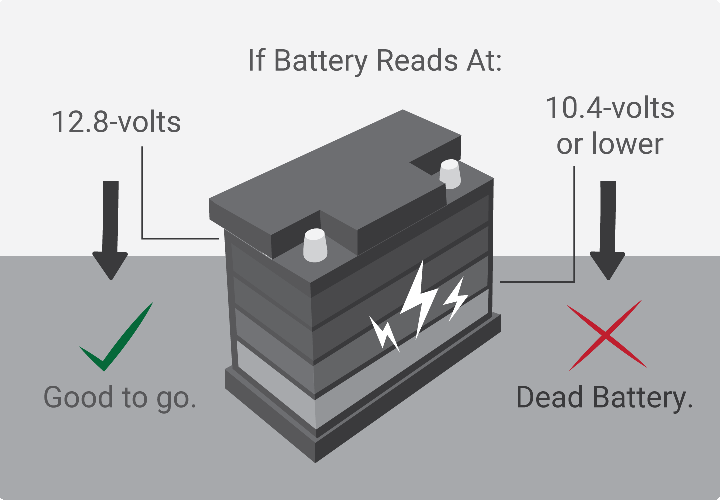
Most vehicles require at least 10.5 volts to start, which is about the charge of a fully drained battery. If you forget the interior lights are “on” or another electrical load is on, it’s easy to drain the battery to a level below 10 volts. You can quickly rule out the cause of a dead battery by checking the battery’s open circuit voltage. For example, if your vehicle is measuring 12.8 volts and won’t start, you can rule out a dead battery as a possible cause. If the cause is a dead battery, remember to leave the vehicle running for 2-3 hours or connect it to a smart battery charger. It’s critical to the life of the battery that it receives a full charge after a deep discharge.
Battery failure
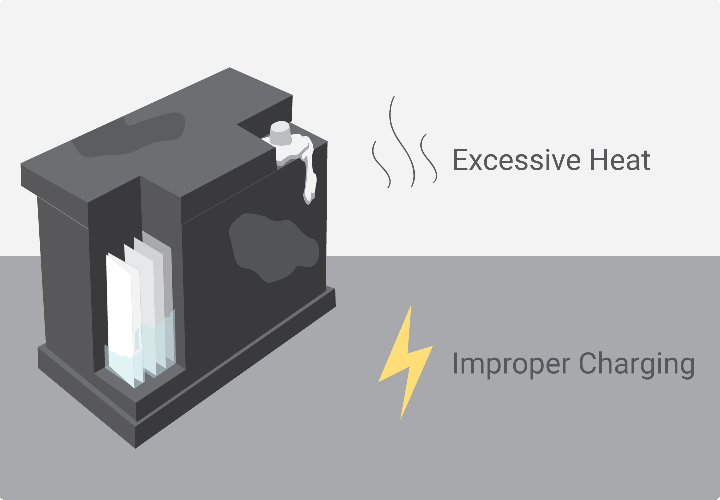
Battery failure can be caused by a variety of factors, including quality, age, misuse, heat, and improper charging. The two most common causes of battery failure are battery sulfation and a short circuit within the battery. Battery sulfation is a condition that develops in lead-acid batteries due to a lack of full charge or due to being left in a discharged state. Over time, the condition worsens, reducing capacity. Ultimately, battery sulfation causes the battery to become unable to hold a charge and have difficulty maintaining the voltage needed to start the vehicle. A short circuit in a battery cell occurs when two of the battery’s internal plates come into contact with each other. As a result, the battery cells short circuit and the 12-volt battery essentially becomes a 10-volt battery. Internal cell contact occurs when the battery separator (the material that separates the battery cells) becomes damaged. Battery cells fail for a variety of reasons. Some of the most common reasons are excessive ambient heat, overcharging, overdischarging, and excessive charging rate. The easiest way to determine if your battery is damaged is to perform an electrical load test.
Bad electrical connections
A loose battery cable or battery connection restricts current flow. Similarly, a damaged or worn battery cable can restrict current flow. Check for dry, cracked, and peeling plastic insulation on the battery cable. Make sure all battery connections are secure and replace any battery cables or battery terminals if damaged.
Battery corrosion
Battery corrosion is a great resistance. The presence of battery corrosion can significantly limit the flow of current. If present, clean and remove all battery corrosion. See our ultimate guide to Cleaning and Removing Battery Corrosion.
Starter failure
A faulty starter reacts very similarly to a damaged battery and a faulty charging system. However, make sure your battery is healthy and fully charged and that the charging systems are working properly. If the starter is damaged, the engine will likely crank over very slowly and the interior and exterior lights will dim. Additionally, experts have observed that the battery terminals and battery cables become excessively hot when the starter is malfunctioning.
Charging system failure
A properly functioning charging system should provide a charging voltage of approximately 14 volts. This is the baseline voltage when the vehicle is idling and no loads are “on”. The charging voltage from the alternator will vary depending on the state of charge of the connected battery, the load on the electrical system and the ambient temperature. In cold weather, the charging voltage is higher. In warm weather, the charging voltage is lower. For example, the charging voltage range in high temperatures can be 13.9-14.4V, while in low temperatures it can be 14.9-15.8V. If the charging system is not providing sufficient voltage, the problem may be with the alternator or the regulator. To determine the possible cause, you can bypass the regulator. If the charging voltage starts to increase, then the problem is with the regulator. If there is no change in the charging voltage, the problem is with the alternator. Most often, the problem is with the alternator. What happens is that one or more of the diodes in the alternator fail, causing the charging voltage to drop. Although the alternator is still producing current, its output voltage is now too low to replenish the lost battery capacity. If you had an oscilloscope, you could identify this problem from the alternator waveform. Another quick and easy method for checking the alternator is to run the car and then disconnect the positive battery cable from the battery. If the vehicle shuts off, then there is probably a problem with the alternator.
Clutch switch failure
Sometimes the clutch safety switch fails or malfunctions. This is the safety switch that allows your vehicle to start by depressing or engaging the clutch.
When the engine turns over with the starter, but does not start
Ignition failure
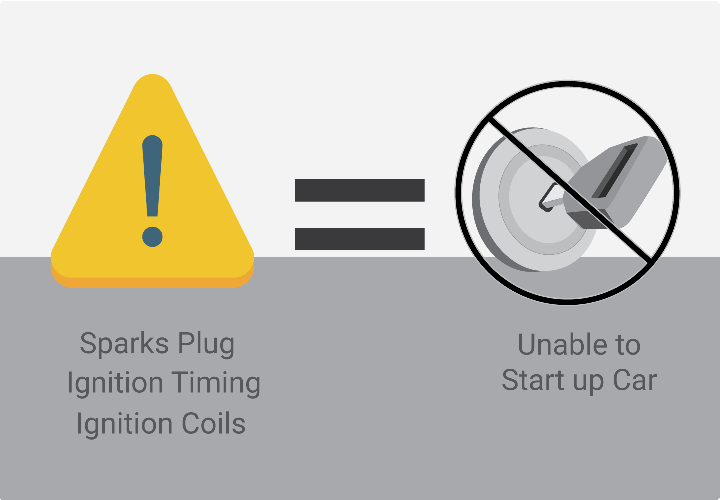
All vehicles need a spark (or compression) to ignite the fuel and start. Problems with the spark plugs or ignition coils can lead to starting problems. Ignition timing problems are also possible, as the sparks must be produced at the exact moment and with the correct amount of voltage. Warning signs are usually present before the ignition system fails. If the vehicle is difficult to start, does not run smoothly, or is simply difficult to start, these are the initial symptoms. To identify ignition problems, pull the spark plug wire and ground the wire to a metal surface in the engine. Make sure there are no flammable liquids nearby (e.g. gasoline) and do not hold the spark plug wire, as this can cause an electric shock. Crank the engine and check for spark. If you see spark, the problem is not with the spark plug. If you don't see a spark, the problem could be a faulty distributor, a loose coil, a faulty crankshaft, or a faulty camshaft position sensor. Then, check the fault codes with a scanner for any errors. If the results are negative, use a multimeter to check the fuses and relays. Check for resistance at the sensors. Check for power to the coil. If there is voltage, the coil is faulty.
Lack of gasoline
It sounds silly, but it happens to the best of us. An engine needs to compress fuel to turn over. If the tank is empty, then the engine may crank over but the vehicle will not start. Fill it up with fuel and remember that running your vehicle on little or no fuel is not good for the fuel pump or fuel filter.
Worn starter
The gears, rings, and bearings of the alternator can wear out and cause the vehicle to start. It is easy to spot a worn starter. If your headlights are bright when the vehicle is "off", but dim when the engine is "on", it may need to be replaced.
Clogged air filter
Make sure the cylinders are getting plenty of air. Check the air filter and make sure it is not clogged. Inspect any duct inlets or air intakes that may be clogged with debris. However, lack of air flow is rarely the cause of a vehicle not starting, but it is worth investigating.
Clogged fuel filter or injectors
Like an air filter, the fuel system can become clogged, and fuel may not be reaching the engine. When the engine is not getting enough fuel, the problem could be a faulty fuel pressure regulator, a fuel leak, a clogged fuel filter, or clogged fuel injectors. The most common is a faulty fuel pump. The fuel pump can be checked fairly easily. Locate the fuel pump and listen carefully when starting the engine. There should be a whistling sound as the pump primes. If not, then the fuel pump is not getting enough power. Use a multimeter to test the fuel pump. If it has voltage, then the fuel pump is probably bad.
Defective fuel pump
The main purpose of fuel pumps is to pump fuel from the tank to the engine. The most common symptoms of a bad fuel pump valve are: the engine misfires at high speeds, loses power during acceleration, has a sudden loss of power or surges, which ultimately leads to the engine not being able to start. In such a case, the engine will continue to rotate, but will never start, as fuel is not reaching the engine. To identify a fuel pump failure, check for a blown fuse and if there is pressure in the fuel line.